
Get set up
You can read this page without running anything. To run the code yourself, the easiest way needs nothing installed, only a web browser and a free Google account:
- Open this lesson in Google Colab. Colab is Google's free service for running Python notebooks in the browser; sign in with your Google account if asked.
- Run the cells in order, from the top: click the ▶ button at the left of a cell, or click inside it and press Shift+Enter. The first cell installs what the lesson needs and takes a minute or two.
- If Colab warns "This notebook was not authored by Google", click Run anyway: the notebook comes from this course's own repository.
- Under each cell you should see what the box labelled Output under the same code on the lesson's page shows (the notebook opens with our outputs already in place; running a cell replaces them with yours). Boxes labelled Example output show timings or memory, so your numbers will differ a little.
New to notebooks, or want to run the lessons on your own computer instead (with Jupyter, Anaconda or a terminal)? Start here shows every step.
If you already work in a terminal, the short version, with uv and Git installed:
git clone https://github.com/David-Alobo/monstrous-learn.git
cd monstrous-learn/data-engineering/series-1
uv sync
uv run python 07-standardisation/code.py
or, in any Python 3.11+ environment: python -m pip install rdkit pandas pyarrow.
A compound reaches a database in many forms. One vendor sells it as the free base, another as the hydrochloride salt, a third writes the salt with the charges drawn in, and an assay file records it with a molecule of solvent. Chemically these are one compound under test; as records they have different SMILES and different InChIKeys, so a database that stores them as they come holds four compounds, splits their assay results four ways, and never notices.
Standardisation turns every record into one canonical form (one agreed way of writing the compound) before its identity is computed and before it is stored. It is a transformation of the data, so it needs the same care as any code that changes data: it must be a single function that always gives the same answer for the same input, its rules must carry a version number that is stored with every output, and it must be tested.
By the end of this module you will be able to:
- explain the four usual steps (clean up how groups are drawn, keep the main compound and drop salts and solvents, remove charges, and optionally pick one tautomer) and what each one changes;
- run them with RDKit's
rdMolStandardizemodule; - write standardisation as one function whose settings are written down, given a version and a short fingerprint;
- test that running it twice changes nothing, that two ways of writing a molecule give one answer, and that agreed examples come out as agreed;
- run it on a library, store beside each record where it came from and which rules made it, and find the duplicates it reveals;
- judge when picking one tautomer is worth the time it takes.
From earlier modules we use canonical SMILES, the InChIKey and SMARTS patterns
(Module 2), the teaching library chemlib, Parquet files and
finding duplicates by InChIKey (Module 3), and the validation gate
and its idea of fixable faults (Module 6).
The lesson uses RDKit for the chemistry, pandas for tables (a table in pandas is a DataFrame),
pyarrow, which pandas uses to write Parquet files, and chemlib, the course's own package that
makes and damages a teaching library. Everything here runs in a browser notebook (Google Colab) or
on any laptop.
Setup
Everything this lesson needs is imported and set here, so the settings can be changed in one place.
Pipeline steps report with log; print is kept for showing you results; Module 1 explains why.
Besides the packages above, the block imports tools that come with Python itself (its standard
library), each explained where it is first used: hashlib and json make the short fingerprint
of section 3, time measures how long code takes (section 6), Path handles file and folder
names, and Callable and NamedTuple are used to describe and build small records (section 3).
As in Module 6, 4_000 is four thousand (the underscore is only for reading), curly brackets with
plain values make a set (a collection with no order and no repeats), and the comment
# fmt: skip, used later, only tells the course's code formatter to leave a line alone.
import hashlib
import json
import logging
import time
from collections.abc import Callable
from pathlib import Path
from typing import NamedTuple

import pandas as pd
import rdkit
from rdkit import Chem, RDLogger
from rdkit.Chem.MolStandardize import rdMolStandardize

import chemlib

# log lines: level and message only, so the lesson's outputs are the same on every run
# (a real job would add "%(asctime)s" to the format)
logging.basicConfig(level=logging.INFO, format="%(levelname)s %(message)s", force=True)
log = logging.getLogger(__name__)

# tests of the standardiser (section 4): a sample of the library, and random SMILES of each
TEST_SAMPLE_SIZE = 500  # molecules checked for idempotency and invariance
TEST_SAMPLE_SEED = 31
RANDOM_SMILES = 3  # randomly written SMILES per molecule in the invariance test
RANDOM_SMILES_SEED = 7

# the dirty library of section 5: change the size or seeds for another sample
LIBRARY_SIZE = 4_000  # molecules made by chemlib for vendor A
LIBRARY_SEED = 21
DEFECT_RATE = 0.05  # fraction of molecules given a fault by add_defects
DEFECT_SEED = 22
VENDOR_B_SIZE = 200  # vendor A compounds that vendor B also sells, as salts
VENDOR_B_SEED = 5

# the short validation gate of section 5 (Module 6 has the full one)
ALLOWED_ELEMENTS = {"H", "B", "C", "N", "O", "F", "P", "S", "Cl", "Br", "I"}
SALTS_AND_SOLVENTS = {"Cl", "[Cl-]", "Br", "[Na+]", "[K+]", "O=C(O)C(F)(F)F", "O", "CCO", "CO"}

TAUTOMER_SAMPLE_SIZE = 200  # molecules timed with and without the tautomer step (section 6)
WORK = Path("work")  # where the standardised table is written

WORK.mkdir(exist_ok=True)
1. One compound, many records
Take one molecule from the course's teaching library (chemlib, as in Module 6), a benzamide with a
basic piperidine, and write it the ways real files do. In SMILES a full stop separates two pieces
in one record, so .Cl is hydrogen chloride beside the compound and .O a molecule of water;
{name:22} in the f-string pads each name to 22 characters so the keys line up:
records = {
    "free base": "O=C(NCc1ccc(F)cc1)c1ccc(C2CCNCC2)cc1",
    "hydrochloride, as HCl": "O=C(NCc1ccc(F)cc1)c1ccc(C2CCNCC2)cc1.Cl",
    "hydrochloride, ionic": "O=C(NCc1ccc(F)cc1)c1ccc(C2CC[NH2+]CC2)cc1.[Cl-]",
    "hydrate": "O=C(NCc1ccc(F)cc1)c1ccc(C2CCNCC2)cc1.O",
}
for name, smiles in records.items():
    print(f"{name:22} {Chem.MolToInchiKey(Chem.MolFromSmiles(smiles))}")
free base              YJQXKEWIRCHOIN-UHFFFAOYSA-N
hydrochloride, as HCl  FLVGHKUJGSVPDG-UHFFFAOYSA-N
hydrochloride, ionic   FLVGHKUJGSVPDG-UHFFFAOYSA-N
hydrate                QWZLHQPGDUXVNO-UHFFFAOYSA-N
Four records, three identities. The standard InChI already treats the two ways of writing the hydrochloride as one, but the free base, the salt and the hydrate are three different keys. The InChIKey is doing its job, which is to describe exactly what the record contains; it is the records that differ. Standardisation decides, by rule, what the compound is, and only then is the identity computed.
2. The steps
RDKit's rdMolStandardize module provides each step. (It began as a copy, rewritten inside RDKit,
of MolVS, a Python package that has had no release since version 0.1.1 in 2018; use
rdMolStandardize, which is maintained inside RDKit itself.)
Clean-up: one way to draw each group
Some groups can be drawn in more than one way: a sulfoxide as S=O or with separated charges as
[S+][O-]. RDKit's sanitisation already redraws a few (a nitro group written N(=O)=O becomes
[N+](=O)[O-] as it is read; sanitisation is RDKit's check of valences and aromaticity, as in
Module 6), and rdMolStandardize.Cleanup applies a longer list of normalisation rules, each
of which redraws one kind of group in RDKit's preferred way:
for smiles in ["CN(=O)=O", "CS(C)=O", "C[S+](C)[O-]"]:
    mol = Chem.MolFromSmiles(smiles)
    cleaned = rdMolStandardize.Cleanup(mol)
    print(f"{smiles:14} read as {Chem.MolToSmiles(mol):16} cleaned: {Chem.MolToSmiles(cleaned)}")
CN(=O)=O       read as C[N+](=O)[O-]    cleaned: C[N+](=O)[O-]
CS(C)=O        read as CS(C)=O          cleaned: C[S+](C)[O-]
C[S+](C)[O-]   read as C[S+](C)[O-]     cleaned: C[S+](C)[O-]
RDKit's rules draw sulfoxides with separated charges. Another tool's rules may choose S=O;
which convention wins matters much less than applying one convention to every record.
The parent: strip salts and solvents
The parent is the compound without its counter-ions and solvents. The simplest rule, and the
usual one, keeps the largest organic fragment (a fragment is one of the separate pieces of a
record). In RDKit this is an object, a LargestFragmentChooser, that is made once with its
settings and then used with chooser.choose(mol):
chooser = rdMolStandardize.LargestFragmentChooser(preferOrganic=True)
for name in ["hydrochloride, as HCl", "hydrate"]:
    parent = chooser.choose(Chem.MolFromSmiles(records[name]))
    print(f"{name:22} -> {Chem.MolToSmiles(parent)}")
hydrochloride, as HCl  -> O=C(NCc1ccc(F)cc1)c1ccc(C2CCNCC2)cc1
hydrate                -> O=C(NCc1ccc(F)cc1)c1ccc(C2CCNCC2)cc1
"Largest" fails for mixtures of two drug-sized compounds, which is why Module 6 rejects mixtures before they reach this step.
Neutralise
After the counter-ion has gone, a protonated amine is left with a charge. The uncharger adds or removes hydrogens to neutralise charges where it can, leaving charges it cannot remove (a quaternary ammonium has no hydrogen to lose):
uncharger = rdMolStandardize.Uncharger()
for smiles in ["CC[NH3+]", "CC(=O)[O-]", "[NH3+]CC(=O)[O-]", "C[N+](C)(C)C"]:
    neutral = uncharger.uncharge(Chem.MolFromSmiles(smiles))
    print(f"{smiles:18} -> {Chem.MolToSmiles(neutral)}")
CC[NH3+]           -> CCN
CC(=O)[O-]         -> CC(=O)O
[NH3+]CC(=O)[O-]   -> NCC(=O)O
C[N+](C)(C)C       -> C[N+](C)(C)C
The neutral form is a convention for identity, not a claim about the compound in water: glycine is a zwitterion at pH 7. Store the neutral parent for identity and searching; compute charge states at a given pH separately when a model needs them.
Canonical tautomer
Tautomers differ only by where a hydrogen sits (2-hydroxypyridine and 2-pyridone). The
TautomerEnumerator lists a molecule's tautomers, scores them by fixed rules and returns the best,
so every tautomer of a compound gives the same output:
enumerator = rdMolStandardize.TautomerEnumerator()
for smiles in ["Oc1ccccn1", "O=c1cccc[nH]1", "O=C1C=CCC=C1"]:
    canonical = enumerator.Canonicalize(Chem.MolFromSmiles(smiles))
    print(f"{smiles:14} -> {Chem.MolToSmiles(canonical)}")
Oc1ccccn1      -> O=c1cccc[nH]1
O=c1cccc[nH]1  -> O=c1cccc[nH]1
O=C1C=CCC=C1   -> Oc1ccccc1
The first two records are one compound and now give one output. The third shows that the step can change aromaticity: a non-aromatic cyclohexadienone becomes phenol, its aromatic tautomer. It is the most expensive step and the one that changes the most; section 6 measures what it costs and shows when to skip it.
3. One pure function, with versioned rules
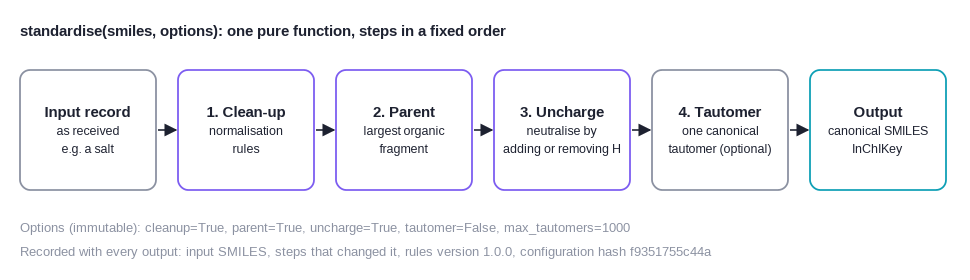
Each step is a choice (which fragment, which charges, which tautomer, how many tautomers to try), and a change to any of them changes the output for some molecules. So the whole of standardisation is written as one pure function: the same input and the same options always give the same output, and it reads and changes nothing else (no settings hidden elsewhere, no files, no clock). Its options are an immutable object, one that cannot be changed after it is made, and the rules carry a version and a short hash of the full configuration, recorded with every output.
A hash is a fingerprint of a piece of text: a short string of letters and digits computed from it, which changes completely if any character of the text changes. So two outputs with the same hash were made with exactly the same settings. The code below works in four small steps:
Optionsis a named tuple (Module 6), a small record with named fields, here each with a default value after the=;Options(tautomer=True)makes one with only that field changed;options._asdict()turns it into a dictionary, and**copies that dictionary's entries into the new dictionaryconfig, beside the rules version and the RDKit version;json.dumps(config, sort_keys=True)writes the dictionary as one line of text, with its keys always in the same order, so the same settings always give the same text;hashlib.sha256(...)computes the hash of that text (as bytes, hence.encode("utf-8")), and.hexdigest()[:12]keeps its first 12 characters, which is plenty to tell configurations apart:
RULES_VERSION = "1.0.0"  # change it whenever a step or a default changes


class Options(NamedTuple):
    """Which standardisation steps to run, and their settings. Immutable, so it can be hashed."""

    cleanup: bool = True
    parent: bool = True
    uncharge: bool = True
    tautomer: bool = False
    max_tautomers: int = 1000


def config_hash(options: Options) -> str:
    """A short fingerprint of everything that decides the output: the rules, options and RDKit."""
    config = {"rules": RULES_VERSION, "rdkit": rdkit.__version__, **options._asdict()}
    text = json.dumps(config, sort_keys=True)
    return hashlib.sha256(text.encode("utf-8")).hexdigest()[:12]


DEFAULT = Options()
WITH_TAUTOMERS = Options(tautomer=True)
print("default:       ", config_hash(DEFAULT))
print("with tautomers:", config_hash(WITH_TAUTOMERS))
default:        f9351755c44a
with tautomers: ef5ea73b092f
The RDKit version is part of the hash because a new release can change a rule or a canonical SMILES; the same options under another RDKit are another configuration.
The function itself runs the steps that are switched on, in a fixed order, and notes which ones changed the molecule. It is built from two parts:
steps_formakes the list of steps for a set of options. Each step is a pair: its name and the function that does it (written without brackets, so it is stored, not run). The type hintCallable[[Chem.Mol], Chem.Mol]says each such function takes a molecule and returns one.standardisereads the SMILES, then runs each step in turn, comparing the SMILES before and after to see whether the step changed anything.{smiles!r}in the error message shows the SMILES in quotes, andraise ValueError(...)stops with that message, because an unreadable SMILES should never reach this function. The result is another named tuple,Standardised;tuple[str, ...]means a tuple of any number of strings.
class Standardised(NamedTuple):
    """The canonical SMILES of a record and the steps that changed it."""

    smiles: str
    changed_by: tuple[str, ...]


def steps_for(options: Options) -> list[tuple[str, Callable[[Chem.Mol], Chem.Mol]]]:
    """The standardisation steps switched on in `options`, in the order they run."""
    steps = []
    if options.cleanup:
        steps.append(("cleanup", rdMolStandardize.Cleanup))
    if options.parent:
        chooser = rdMolStandardize.LargestFragmentChooser(preferOrganic=True)
        steps.append(("parent", chooser.choose))
    if options.uncharge:
        steps.append(("uncharge", rdMolStandardize.Uncharger().uncharge))
    if options.tautomer:
        params = rdMolStandardize.CleanupParameters()
        params.maxTautomers = options.max_tautomers
        enumerator = rdMolStandardize.TautomerEnumerator(params)
        steps.append(("tautomer", enumerator.Canonicalize))
    return steps


def standardise(smiles: str, options: Options = DEFAULT) -> Standardised:
    """The canonical form of one record under `options`. Pure: nothing else is read or changed.

    Raises ValueError for SMILES that cannot be read: validate first (Module 6).
    """
    mol = Chem.MolFromSmiles(smiles)
    if mol is None:
        raise ValueError(f"cannot read {smiles!r}: validate it first")
    changed_by = []
    for name, step in steps_for(options):
        before = Chem.MolToSmiles(mol)
        mol = step(mol)
        if Chem.MolToSmiles(mol) != before:
            changed_by.append(name)
    return Standardised(Chem.MolToSmiles(mol), tuple(changed_by))


for name, smiles in records.items():
    result = standardise(smiles)
    print(f"{name:22} {result.smiles}  changed by: {', '.join(result.changed_by) or '-'}")
free base              O=C(NCc1ccc(F)cc1)c1ccc(C2CCNCC2)cc1  changed by: -
hydrochloride, as HCl  O=C(NCc1ccc(F)cc1)c1ccc(C2CCNCC2)cc1  changed by: parent
hydrochloride, ionic   O=C(NCc1ccc(F)cc1)c1ccc(C2CCNCC2)cc1  changed by: parent, uncharge
hydrate                O=C(NCc1ccc(F)cc1)c1ccc(C2CCNCC2)cc1  changed by: parent
The four records of section 1 are now one compound. A batch job, a web form and a notebook that
all call standardise get the same answer, because nothing else is involved.
4. Testing it like software
A standardiser touches every structure in the database, so a bug in it is a bug everywhere. Three
kinds of test catch most of them. Each test is a function full of assert lines; assert stops the
program with an error if what follows it is False, so a test that runs to the end has passed.
Known cases pin down behaviour that chemists have agreed on. If a rule changes and one of these breaks, the change was not harmless:
def test_known_cases() -> None:
    """Records whose standard form is agreed in advance."""
    assert standardise("CC(=O)[O-].[Na+]").smiles == "CC(=O)O"  # sodium acetate -> acetic acid
    assert standardise("[NH3+]CC(=O)[O-]").smiles == "NCC(=O)O"  # zwitterion -> neutral glycine
    assert standardise("CCN(CC)CC.Cl").smiles == "CCN(CC)CC"  # salt stripped
    pyridone = standardise("O=c1cccc[nH]1", WITH_TAUTOMERS).smiles
    assert standardise("Oc1ccccn1", WITH_TAUTOMERS).smiles == pyridone  # a tautomer pair
    assert standardise("Oc1ccccn1").smiles != pyridone  # ... and without the tautomer step


test_known_cases()
log.info("known cases pass")
INFO known cases pass
Idempotency (from Latin for "the same power"): standardising a standard form changes nothing,
standardise(standardise(x)) == standardise(x). If it fails, a record's identity depends on how
many times it went through the pipeline. Invariance: different SMILES of the same molecule give
the same output. If it fails, the identity depends on how the vendor happened to write the record.
Both are properties that must hold for every molecule, so we test them on many.
For the invariance test, Chem.MolToRandomSmilesVect(mol, n, randomSeed=...) writes n different,
randomly ordered but valid SMILES of the same molecule (the seed makes the random choice the same
on every run). [smiles, *variants] is a list of the original SMILES followed by all the variants,
and the curly brackets around the comprehension make a set of the outputs: if the set holds one
SMILES, every variant gave the same answer:
def is_idempotent(smiles: str, options: Options = DEFAULT) -> bool:
    """Standardising the output again gives the output."""
    once = standardise(smiles, options).smiles
    return standardise(once, options).smiles == once


def is_invariant(smiles: str, options: Options = DEFAULT, n: int = RANDOM_SMILES) -> bool:
    """n randomly written SMILES of the same molecule all give one output."""
    mol = Chem.MolFromSmiles(smiles)
    variants = Chem.MolToRandomSmilesVect(mol, n, randomSeed=RANDOM_SMILES_SEED)
    return len({standardise(s, options).smiles for s in [smiles, *variants]}) == 1


sample = chemlib.library(TEST_SAMPLE_SIZE, seed=TEST_SAMPLE_SEED)["smiles"]
log.info("idempotent: %d of %d", sum(is_idempotent(s) for s in sample), len(sample))
log.info("invariant: %d of %d", sum(is_invariant(s) for s in sample), len(sample))
INFO idempotent: 500 of 500
INFO invariant: 500 of 500
All 500 molecules pass both tests. In a project these functions live in a test file
(test_standardise.py) and are run by pytest, a Python package for running tests, which finds
every function whose name starts with test_ and reports each failure with the values involved.
Continuous integration, a service that runs the tests automatically every time the code is
changed, runs them on every change (Module 13). The plain asserts here are exactly what pytest
runs. You do not need pytest for this lesson: in the notebook we call the test functions
ourselves.
5. Standardising a dirty library
Validate first
Standardisation assumes a molecule that can be read and is worth keeping, so it runs after the
validation gate. Here is a short version of Module 6's gate: records that cannot be read, or that
contain an element outside the allow-list (ALLOWED_ELEMENTS, set in the Setup block) or a fragment
that is neither a known salt nor a known solvent (SALTS_AND_SOLVENTS), are rejected; everything
else goes on. Unlike Module 6, this short gate keeps no reasons, only the verdict, so it switches
RDKit's messages off with RDLogger.DisableLog. As in Module 6, the largest piece is found with
max(..., key=lambda s: ...): a lambda is a one-line function without a name, here giving the
number of heavy atoms of a SMILES s, and max keeps the piece for which it is highest:
RDLogger.DisableLog("rdApp.*")  # the reasons are Module 6's subject; here we only need verdicts


def gate(smiles: str) -> str:
    """'reject' for unreadable records, foreign elements or unknown fragments; else 'pass'."""
    mol = Chem.MolFromSmiles(smiles)
    if mol is None:
        return "reject"
    if {atom.GetSymbol() for atom in mol.GetAtoms()} - ALLOWED_ELEMENTS:
        return "reject"
    pieces = sorted(Chem.MolToSmiles(f) for f in Chem.GetMolFrags(mol, asMols=True))
    largest = max(pieces, key=lambda s: Chem.MolFromSmiles(s).GetNumHeavyAtoms())
    if any(p not in SALTS_AND_SOLVENTS for p in pieces if p != largest):
        return "reject"
    return "pass"


library = chemlib.library(LIBRARY_SIZE, seed=LIBRARY_SEED)
vendor_a = chemlib.add_defects(library, rate=DEFECT_RATE, seed=DEFECT_SEED)
vendor_a["verdict"] = [gate(s) for s in vendor_a["smiles"]]
print(pd.crosstab(vendor_a["defect"].replace("", "(none)"), vendor_a["verdict"]).to_string())
verdict    pass  reject
defect
(none)     3833       0
duplicate    33       0
element       0      33
invalid       0      33
salt         34       0
solvent      34       0
valence       0      33
As in Module 6, records that cannot be read and selenium records are rejected. Salts and solvates pass this time, because standardisation can repair them, and the duplicates pass, as they should: they are good records, and standardisation is where they are found.
A second supplier
Duplicates hidden by salts appear when sources are merged. A second supplier, vendor B, sells some of vendor A's compounds that have a basic amine, as hydrochloride salts written with the charges drawn in, or as trifluoroacetate (TFA) salts, the usual form after purification by HPLC. We make its catalogue from vendor A's records.
This step only builds test data, so you can read it lightly. It finds a basic amine with a SMARTS
pattern (Module 2), BASIC_AMINE: a nitrogen with one or two hydrogens that is not part of an
amide, not attached to an aromatic ring and not bonded to another S, N or O. as_hydrochloride
then puts a hydrogen and a + charge on the first such nitrogen and adds a chloride ion. It uses
Chem.RWMol, an editable copy of a molecule (RDKit's ordinary molecules cannot be changed atom
by atom). The table of vendor B is made with a comprehension that alternates between the two
kinds of salt: k % 2 == 0 is True for even row numbers, which become hydrochlorides, and the odd
ones get a TFA salt. The ids are written with {k:05d}, a whole number padded with zeros to five
digits:
BASIC_AMINE = Chem.MolFromSmarts("[NX3;H2,H1;!$(N-C=[O,N,S]);!$(N-a);!$(N-[S,N,O])]")


def as_hydrochloride(smiles: str) -> str:
    """The compound with its first basic amine protonated, and a chloride ion beside it."""
    mol = Chem.RWMol(Chem.MolFromSmiles(smiles))
    atom = mol.GetAtomWithIdx(mol.GetSubstructMatch(BASIC_AMINE)[0])
    atom.SetFormalCharge(1)
    atom.SetNumExplicitHs(atom.GetTotalNumHs() + 1)
    Chem.SanitizeMol(mol)
    return Chem.MolToSmiles(mol) + ".[Cl-]"


passed = vendor_a[(vendor_a["verdict"] == "pass") & (vendor_a["defect"] == "")]
basic = passed[[Chem.MolFromSmiles(s).HasSubstructMatch(BASIC_AMINE) for s in passed["smiles"]]]
picked = basic.sample(VENDOR_B_SIZE, random_state=VENDOR_B_SEED).sort_values("id")
vendor_b = pd.DataFrame(
    {
        "id": [f"VB-{k:05d}" for k in range(len(picked))],
        "smiles": [
            as_hydrochloride(s) if k % 2 == 0 else s + ".O=C(O)C(F)(F)F"
            for k, s in enumerate(picked["smiles"])
        ],
    }
)
print(len(basic), "of vendor A's clean records have a basic amine; vendor B sells", len(vendor_b))
print(vendor_b.head(2).to_string(index=False))
906 of vendor A's clean records have a basic amine; vendor B sells 200
      id                                                              smiles
VB-00000              CCOc1ccccc1Oc1ccc(C(=O)N(C(C)C)C2CC[NH2+]CC2)cc1.[Cl-]
VB-00001 c1cc(C8CCNCC8)c(cc1)Oc2ccc(cc2)C(=O)N(C(C)C)C(F)(F)F.O=C(O)C(F)(F)F
Run it, with provenance
Provenance is the record of where a piece of data came from and what was done to it. Every
record that passed the gate, from both suppliers, goes through standardise, after pd.concat
has joined the two suppliers' tables into one (ignore_index=True numbers the rows afresh). The
output
keeps the input SMILES beside the standard one, with the steps that changed it, the rules version
and the configuration hash. Anyone can later see where a structure came from and which rules made
it, and records made under old rules can be found and re-run when the rules change:
merged = pd.concat(
    [vendor_a.loc[vendor_a["verdict"] == "pass", ["id", "smiles"]], vendor_b],
    ignore_index=True,
)
results = [standardise(s) for s in merged["smiles"]]
standard = pd.DataFrame(
    {
        "id": merged["id"],
        "input_smiles": merged["smiles"],
        "smiles": [r.smiles for r in results],
        "changed_by": [",".join(r.changed_by) for r in results],
        "rules_version": RULES_VERSION,
        "config_hash": config_hash(DEFAULT),
    }
)
changed = standard[standard["changed_by"] != ""]
log.info("standardised %d records; %d changed", len(standard), len(changed))
print(changed["changed_by"].value_counts().sort_index().to_string())
INFO standardised 4134 records; 268 changed
changed_by
parent             168
parent,uncharge    100
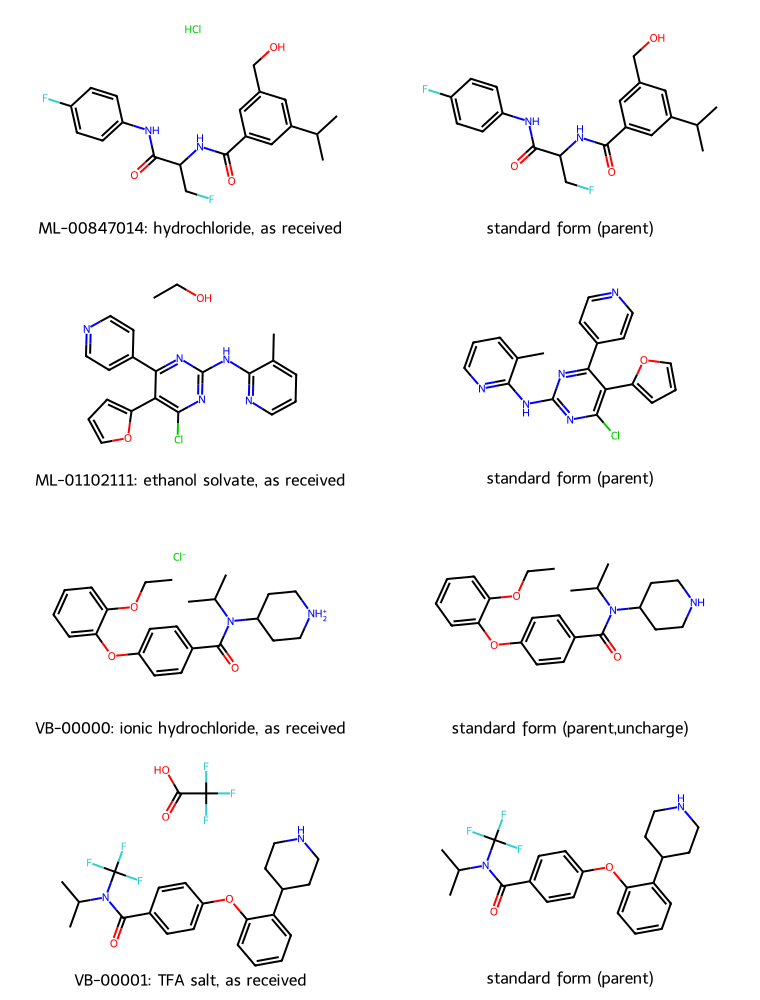
Every change is the parent step or the parent step followed by neutralisation: vendor A's 34 salts and 34 solvates and vendor B's 100 TFA salts lost a fragment, and vendor B's 100 ionic hydrochlorides lost a fragment and a charge. One example of each, before and after:
examples = changed.groupby("changed_by").head(1)
print(examples[["id", "input_smiles", "smiles"]].to_string(index=False, max_colwidth=58))
         id                                           input_smiles                                          smiles
ML-00847014     c1c(CO)cc(cc1C(C)C)C(=O)NC(CF)C(=O)Nc8ccc(F)cc8.Cl CC(C)c1cc(CO)cc(C(=O)NC(CF)C(=O)Nc2ccc(F)cc2)c1
   VB-00000 CCOc1ccccc1Oc1ccc(C(=O)N(C(C)C)C2CC[NH2+]CC2)cc1.[Cl-]     CCOc1ccccc1Oc1ccc(C(=O)N(C(C)C)C2CCNCC2)cc1
Duplicates that only standardisation reveals
Now compare identities. The InChIKey of each record as received, and of its standard form. A
duplicate group is an InChIKey held by more than one record; value_counts counts the records
for each key, and the groups are the keys counted more than once:
def inchikey(smiles: str) -> str:
    """The InChIKey of a SMILES."""
    return Chem.MolToInchiKey(Chem.MolFromSmiles(smiles))


standard["inchikey_in"] = [inchikey(s) for s in standard["input_smiles"]]
standard["inchikey"] = [inchikey(s) for s in standard["smiles"]]


def duplicate_groups(keys: pd.Series) -> int:
    """How many identities are held by more than one record."""
    sizes = keys.value_counts()
    return int((sizes > 1).sum())


before = duplicate_groups(standard["inchikey_in"])
after = duplicate_groups(standard["inchikey"])
print("duplicate groups before standardisation:", before)
print("duplicate groups after standardisation: ", after)
distinct_in, distinct_out = standard["inchikey_in"].nunique(), standard["inchikey"].nunique()
print("distinct compounds:", distinct_in, "->", distinct_out)
duplicate groups before standardisation: 37
duplicate groups after standardisation:  236
distinct compounds: 4097 -> 3897
Standardisation turned 37 duplicate groups into 236, and the number of distinct compounds fell by
200. Which records did it join? Those whose identities differed before and agree after. The code
groups the records by their new InChIKey: agg(sorted) collects the sorted ids in each group, and a
group joins records that differed before if it holds more than one old InChIKey (nunique() > 1
counts the distinct old keys). i.startswith("VB-") picks out vendor B's records by their id:
group_ids = standard.groupby("inchikey")["id"].agg(sorted)
joined = group_ids[standard.groupby("inchikey")["inchikey_in"].nunique() > 1]
print(len(joined), "groups join records whose InChIKeys differed before; the first three:")
for key, ids in joined.head(3).items():
    print(f"  {key}: {', '.join(ids)}")
with_vendor_b = sum(any(i.startswith("VB-") for i in ids) for ids in joined)
grown = sum(standard.loc[standard["inchikey"] == key, "inchikey_in"].duplicated().any()
            for key in joined.index)  # fmt: skip
print(with_vendor_b, "of them include a vendor B record;", grown, "already held a duplicate before")
200 groups join records whose InChIKeys differed before; the first three:
  ACIFUBKVQIZHAZ-UHFFFAOYSA-N: ML-01112212, VB-00113
  ACQBWWYNHXOFBE-UHFFFAOYSA-N: ML-00838364, VB-00079
  ADGTYJCSQSHQNF-UHFFFAOYSA-N: ML-00614039, VB-00061
200 of them include a vendor B record; 1 already held a duplicate before
Every one of vendor B's 200 salts has found the vendor A record it came from: 199 new duplicate
groups, and one vendor B record that joined a pair already there (a vendor A record and its planted
duplicate), which is why the count grew by 199, not 200. Vendor A's own 68 salts and solvates were
repaired but matched nothing else, which is what we expect: add_defects damaged different
molecules from the ones it duplicated. In a real merge, these joins are where assay results from
two suppliers meet for the first time.
Finally the table is written out as a Parquet file (Module 3), with its provenance columns, ready for loading into a database (Module 4):
standard_path = WORK / "standardised.parquet"
standard.to_parquet(standard_path, index=False)
log.info("wrote %d records to %s", len(standard), standard_path.as_posix())
print(standard.columns.tolist())
INFO wrote 4134 records to work/standardised.parquet
['id', 'input_smiles', 'smiles', 'changed_by', 'rules_version', 'config_hash', 'inchikey_in', 'inchikey']
6. Tautomers: what they cost and when to skip them
The default configuration above leaves tautomers alone. Here is why. First, the cost, on 200
molecules from the library (timings differ from computer to computer, so yours will not match).
time.perf_counter() reads a clock, so the difference between two readings is the time the code
between them took, in seconds; we multiply by 1000 for milliseconds and divide by the number of
molecules. In the log lines, %.1f is filled in with the number, to one decimal place:
tautomer_sample = library["smiles"].head(TAUTOMER_SAMPLE_SIZE).tolist()
start = time.perf_counter()
plain = [standardise(s) for s in tautomer_sample]
middle = time.perf_counter()
with_tautomers = [standardise(s, WITH_TAUTOMERS) for s in tautomer_sample]
end = time.perf_counter()
log.info("without tautomers: %.1f ms per molecule",
         1000 * (middle - start) / len(tautomer_sample))  # fmt: skip
log.info("with tautomers:    %.1f ms per molecule",
         1000 * (end - middle) / len(tautomer_sample))  # fmt: skip
INFO without tautomers: 3.5 ms per molecule
INFO with tautomers:    12.3 ms per molecule
Here the tautomer step more than doubled the time per molecule. Then, what it changed, and how many
tautomers it had to consider. zip(plain, with_tautomers) walks through the two lists side by side,
giving each molecule's result without and with the tautomer step together, and
enumerator.Enumerate lists all the tautomers RDKit finds for a molecule:
moved = [(p.smiles, t.smiles) for p, t in zip(plain, with_tautomers) if p.smiles != t.smiles]
same_key = sum(
    Chem.MolToInchiKey(Chem.MolFromSmiles(a)) == Chem.MolToInchiKey(Chem.MolFromSmiles(b))
    for a, b in moved
)
print(len(moved), "of", len(tautomer_sample), "changed by the tautomer step;", same_key,
      "of those keep their InChIKey")
print("for example:", moved[0][0], "->", moved[0][1])
counts = [len(enumerator.Enumerate(Chem.MolFromSmiles(s))) for s in tautomer_sample]
print("tautomers per molecule: median", sorted(counts)[len(counts) // 2], " most", max(counts))
3 of 200 changed by the tautomer step; 3 of those keep their InChIKey
for example: CN(C)c1ccc2nc(-c3ccc(-c4ccccc4)cc3)[nH]c2c1 -> CN(C)c1ccc2[nH]c(-c3ccc(-c4ccccc4)cc3)nc2c1
tautomers per molecule: median 2  most 46
Only 3 of the 200 molecules changed, and every one kept its InChIKey: here a benzimidazole had its
NH moved from one ring nitrogen to the other, and the standard InChI already treats those two forms
as one. The step's cost grows with the number of tautomers to enumerate and score: a median of two
per molecule here, but 46 for one of them; molecules with many mobile hydrogens can reach the
enumerator's limit (max_tautomers in our options), and then the answer depends on that limit too.
Some changes look odd to a chemist. A hydroxamic acid, a common metal-binding group in drugs, is turned into its rarely drawn hydroximic acid form:
print(standardise("CC(=O)NO", WITH_TAUTOMERS).smiles)
CC(O)=NO
The tautomer step can also remove stereochemistry. An atom that loses its hydrogen in some tautomer (next to a carbonyl, for example) could invert through that tautomer, so RDKit's default removes its stereo label. An (S)-alanine amide is a chiral drug fragment, and it loses its stereocentre:
alanine_amide = "C[C@H](N)C(=O)NC"
print("default:       ", standardise(alanine_amide).smiles)
print("with tautomers:", standardise(alanine_amide, WITH_TAUTOMERS).smiles)
default:        CNC(=O)[C@H](C)N
with tautomers: CNC(=O)C(C)N
So, when to use it, and when to skip it:
- Identity by InChIKey. The standard InChI already treats many tautomers (those that move a hydrogen between heteroatoms) as one, so most tautomer duplicates are caught without this step: all three changes above kept their InChIKey.
- Identity by canonical SMILES (a SMILES-based database key, or a machine-learning set where two tautomers of one compound could end up one in the training set and one in the test set, so the model is tested on a compound it has already seen): use it, so that tautomers of one compound are one record.
- Stereochemistry matters (single enantiomers): skip it, or set
CleanupParameters().tautomerRemoveSp3Stereo = Falseand record that choice in the options. - Display. The canonical tautomer is a rule's choice, not the form that predominates in solution, as the hydroximic acid shows. Keep the input structure for drawing.
- Large libraries. At ten milliseconds or more per molecule, a million molecules take hours of processor time; spread it over processes (Module 9), or skip it.
Whatever is chosen goes into Options, and so into the configuration hash stored with every
record.
Try it yourself
The homework is a few questions, answered by running code like the code above: in a new cell at
the end of the notebook, or in a script. It is at the end of the lesson's page, and in
homework.md in the module's folder. The answers are published after the cohort's deadline.
Further reading
- Bento, A. P., Hersey, A., Félix, E., Landrum, G., Gaulton, A., Atkinson, F., Bellis, L. J., De Veij, M. & Leach, A. R. (2020). An open source chemical structure curation pipeline using RDKit. Journal of Cheminformatics, 12, 51. https://doi.org/10.1186/s13321-020-00456-1
- Sitzmann, M., Ihlenfeldt, W.-D. & Nicklaus, M. C. (2010). Tautomerism in large databases. Journal of Computer-Aided Molecular Design, 24(6–7), 521–551. https://doi.org/10.1007/s10822-010-9346-4
- The RDKit documentation. rdkit.Chem.MolStandardize.rdMolStandardize module. https://www.rdkit.org/docs/source/rdkit.Chem.MolStandardize.rdMolStandardize.html
- The ChEMBL Structure Pipeline (source code and documentation of its standardiser and parent steps). https://github.com/chembl/ChEMBL_Structure_Pipeline
- The pytest documentation. https://docs.pytest.org/en/stable/
Homework
Answer each question by running code like the code in the lesson: add a new cell at the end of the
lesson's notebook (in Colab, + Code) and work there. Run the whole lesson first, so that its
functions (standardise, config_hash, is_idempotent, is_invariant, inchikey,
duplicate_groups) and its options (DEFAULT, WITH_TAUTOMERS) exist. If you are in a cohort,
you will be told where to send your answers; everyone can check theirs against the answers
published after the cohort's deadline.
- Builds on sections 2 and 3. Run the lesson's
standardiseon these records: sodium salicylateO=C([O-])c1ccccc1O.[Na+], metformin hydrochlorideCN(C)C(=N)NC(=N)N.Cl, acetylcholine chlorideCC(=O)OCC[N+](C)(C)C.[Cl-]andCS(C)=O(DMSO on its own). For example,result = standardise("CS(C)=O"), thenprint(result.smiles, result.changed_by). For each, give the output SMILES and the steps that changed it. One output still carries a charge: why can the uncharger not remove it, and should the validation gate of Module 6 (its charge check, in section 3) accept that record? - Builds on section 2, "Canonical tautomer". Acetylacetone can be written as its keto form
CC(=O)CC(C)=Oor its enol formCC(O)=CC(C)=O; these are two tautomers, forms that differ only by where a hydrogen sits. Do the two give the same output with the default options (standardise(smiles))? WithWITH_TAUTOMERS(standardise(smiles, WITH_TAUTOMERS))? Do they have the same InChIKey (use the lesson'sinchikeyfunction)? Use your answers to explain which tautomers the standard InChI already treats as one, and which it does not. - Builds on section 4. Test idempotency (standardising the output again changes nothing) and
invariance (different SMILES of one molecule give one output) with
WITH_TAUTOMERSon the SMILES ofchemlib.library(300, seed=41): callis_idempotent(s, WITH_TAUTOMERS)andis_invariant(s, WITH_TAUTOMERS)for each SMILESsin its"smiles"column. Do all 300 molecules pass both tests? If any fail, show one and explain what you see. - Builds on sections 3 and 5. Make a new options set with the neutralisation step switched off,
Options(uncharge=False). What is its configuration hash (config_hash)? Standardise the lesson's merged table of vendor A and vendor B (merged, from section 5) with it: how many outputs differ from the default, and how many duplicate groups (InChIKeys of the output held by more than one record) do you find now? Explain the difference. - Builds on section 5. Repeat section 5 with a different library:
chemlib.library(3_000, seed=51),add_defects(..., rate=0.06, seed=52), and a vendor B of 150 salts (basic.sample(150, random_state=8)). How many duplicate groups are there before and after standardisation, and how many groups join records whose InChIKeys differed before? - To think about. Builds on sections 3 and 5. Your team wants to change the standardiser (a
new RDKit release, or switching the tautomer step on), and the database already holds two
million standardised records. Using the provenance columns of this module (
input_smiles,changed_by,rules_version,config_hash), describe how you would find out which records the change affects before you make it, how you would store records made under the old and new rules while the change rolls out, and what a reviewer should see before approving it.
How was this module?
Found this module useful? ★ Star the course on GitHub: it helps other chemists find it.