
Get set up
You can read this page without running anything. To run the code yourself, the easiest way needs nothing installed, only a web browser and a free Google account:
- Open this lesson in Google Colab. Colab is Google's free service for running Python notebooks in the browser; sign in with your Google account if asked.
- Run the cells in order, from the top: click the ▶ button at the left of a cell, or click inside it and press Shift+Enter. The first cell installs what the lesson needs and takes a minute or two.
- If Colab warns "This notebook was not authored by Google", click Run anyway: the notebook comes from this course's own repository.
- Under each cell you should see what the box labelled Output under the same code on the lesson's page shows (the notebook opens with our outputs already in place; running a cell replaces them with yours). Boxes labelled Example output show timings or memory, so your numbers will differ a little.
New to notebooks, or want to run the lessons on your own computer instead (with Jupyter, Anaconda or a terminal)? Start here shows every step.
If you already work in a terminal, the short version, with uv and Git installed:
git clone https://github.com/David-Alobo/monstrous-learn.git
cd monstrous-learn/data-engineering/series-1
uv sync
uv run python 06-validating-molecules/code.py
or, in any Python 3.11+ environment: python -m pip install rdkit pandas pyarrow.
Every chemical data set has broken records in it. A vendor file holds a SMILES whose ring is never closed, a carbon with five bonds, a hydrochloride salt written into the structure, a compound with an element the library should never contain. If these records reach the database, they spread: a fingerprint is computed from a salt, a model is trained on a mixture, a search misses a compound because it is stored with its counter-ion. Fourches, Muratov and Tropsha (2010) set out the steps of chemical curation (removing inorganic compounds, salts and mixtures, validating structures, deleting duplicates) and described case studies where curating the raw data significantly improved a model's predictions. Public databases now do this in code: ChEMBL, for example, checks its structures with an open-source pipeline built on RDKit (section 7).
A record here is one row of a data file: one compound, with its ID and its SMILES. A data engineer turns that curation into a gate: every record is read and checked before it is stored, and it leaves the gate in one of two ways. It is accepted, or it is put in quarantine (a separate table of records held back) with the reasons written down. Nothing is dropped without a trace.
By the end of this module you will be able to:
- explain why a SMILES that RDKit cannot read must be kept with a written reason, and never simply left out;
- catch RDKit's own error messages for each record;
- write checks that say what is wrong (a short code, a message and what to do), not just True or False;
- check a molecule's elements, its separate pieces (salts, solvents), its charge, its stereochemistry and its size;
- run the gate over a whole library and make a table of the quarantined records and a count of records for each reason;
- test the gate against a library whose faults are known: what it caught, what it missed and where it raised a false alarm.
From earlier modules we use SMILES, stereochemistry and the InChIKey
(Module 2), the teaching library chemlib, Parquet files and
the InChIKey as a molecule's identity (Module 3), and the habit of
reporting with log and showing values with print (Module 1).
The lesson uses these packages:
- RDKit, the chemistry toolkit: it reads the SMILES and checks the chemistry;
- pandas, for tables (a table in pandas is called a DataFrame);
- pyarrow, which pandas uses to write Parquet files; you never call it yourself;
- chemlib, the course's own small package that makes a teaching library of molecules and can damage it on purpose.
Everything here runs in a browser notebook (Google Colab) or on any laptop.
Setup
Everything this lesson needs is imported and set here, so the settings can be changed in one place.
That includes the library's policy (the elements it allows, the salts and solvents it knows, its
size limits), which section 3 explains check by check: a policy kept in one place can be read,
reviewed and changed without hunting through the code. Pipeline steps report with log; print
is kept for showing you results; Module 1 explains why.
Besides the packages above, the block imports a few tools that come with Python itself (its standard library); each is explained where it is first used:
re, for regular expressions, patterns that match pieces of text (section 2);Counter, a dictionary that counts things (section 4);CallableandNamedTuple, used in type hints, the notes after a colon or->that say what kind of value a function takes or returns (section 2);Path, for file and folder names that work on Windows, macOS and Linux.
A few Python details in the settings: 10_000 is ten thousand (the underscore only makes it easier
to read); curly brackets such as {"H", "B", ...} make a set, a collection with no order and no
repeats, which is quick to check membership in; {"Cl": "hydrogen chloride", ...} is a
dictionary, which looks up a value (the name) from a key (the SMILES); and (6, 50) is a
tuple, a fixed pair of values. The comment # fmt: skip, here and later, tells the course's
code formatter to leave that line's layout alone; you can ignore it. The last line makes the
work folder, if it is not there already, for the files this lesson writes.
import logging
import re
from collections import Counter
from collections.abc import Callable
from pathlib import Path
from typing import NamedTuple

import pandas as pd
from rdkit import Chem, RDLogger, rdBase
from rdkit.Chem import Descriptors

import chemlib

# log lines: level and message only, so the lesson's outputs are the same on every run
# (a real job would add "%(asctime)s" to the format)
logging.basicConfig(level=logging.INFO, format="%(levelname)s %(message)s", force=True)
log = logging.getLogger(__name__)

# the teaching library and the damage done to it: change the size or seeds for another sample
LIBRARY_SIZE = 10_000  # molecules made by chemlib
LIBRARY_SEED = 6
DEFECT_RATE = 0.05  # fraction of molecules given a fault by add_defects
DEFECT_SEED = 7
WORK = Path("work")  # where the accepted records and the quarantine are written

# the library's policy (section 3): edit these lists and limits to suit another collection
ALLOWED_ELEMENTS = {"H", "B", "C", "N", "O", "F", "P", "S", "Cl", "Br", "I"}
SALTS = {"Cl": "hydrogen chloride", "[Cl-]": "chloride", "Br": "hydrogen bromide",
         "[Na+]": "sodium", "[K+]": "potassium", "O=C(O)C(F)(F)F": "trifluoroacetic acid"}
SOLVENTS = {"O": "water", "CCO": "ethanol", "CO": "methanol", "CS(C)=O": "DMSO",
            "ClCCl": "dichloromethane"}  # fmt: skip
HEAVY_ATOMS = (6, 50)  # smallest and largest number of heavy atoms in the largest piece
MAX_WEIGHT = 700.0  # largest molecular weight of the largest piece, in g/mol

WORK.mkdir(exist_ok=True)
1. What goes wrong without a gate
We start from a teaching library made by chemlib (the course's library generator, as in Module 3)
and damage it on purpose with add_defects. The damage is on record: the defect column says
which fault each row was given, so we can check our validator against the truth at the end. (A
validator is the code that does the checking.)
The second print counts the rows of each kind of fault: .replace("", "(none)") gives the
undamaged rows, whose defect is empty, a readable name, value_counts() counts each value, and
sort_index() puts the names in alphabetical order.
library = chemlib.library(LIBRARY_SIZE, seed=LIBRARY_SEED)
dirty = chemlib.add_defects(library, rate=DEFECT_RATE, seed=DEFECT_SEED)
print(len(dirty), "records")
print(dirty["defect"].replace("", "(none)").value_counts().sort_index().to_string())
10083 records
defect
(none)       9583
duplicate      83
element        83
invalid        83
salt           84
solvent        84
valence        83
A rate of 0.05 damaged 500 of the 10,000 molecules, split as evenly as possible across six kinds
of fault: 417 rows were changed in place, and the 83 duplicates were added as new rows. Here is
one example of each, as the file holds it. groupby("defect").head(1) keeps the first row of each
kind of fault, iterrows() goes through those rows one at a time, and {row['defect']:10} in the
f-string pads the name to 10 characters so the SMILES line up:
for kind, row in dirty[dirty["defect"] != ""].groupby("defect").head(1).iterrows():
    print(f"{row['defect']:10} {row['smiles']}")
valence    C(C)(C)(C)(C)c1cc(Cl)c(nc1)Nc2nc(N8CCOCC8)c(c8cn[nH]c8)c(Br)n2
duplicate  S(=O)(c1cccc(c1)C(NC(C(NC)=O)CN1CCOCC1)=O)(=O)C
solvent    c1cc(c8cn[nH]c8)c(nc1)Nc2nc(c8ccc(F)cc8)c(C(=O)N)c(N(C)C)n2.CCO
element    c1c(c8ccc(F)cc8)cc(cc1c8ccco8)[Se](=O)NC(CC)C(=O)NO
salt       c1cc(c8ccco8)c(nc1)Nc2nc(C(=O)C)c(O)c(CN)n2.Cl
invalid    ccc(N8CCCC8)c(nc1)Nc2nc(C(=O)C)c(C(C)C)c(C8CC8)n2
A valence fault is an atom with more bonds than it can have (here a carbon with five), and an
invalid SMILES is one RDKit cannot read at all (here the ring-closing 1 at the start has been
cut off).
The usual first script reads every SMILES with RDKit, silences RDKit's warnings because they clutter
the screen, and keeps what worked. It is written with list comprehensions, the short form
[f(x) for x in items] that makes a list by doing one thing to each item, with an optional
if to keep only some. sum(test for m in kept) counts the molecules for which the test is
True, because Python counts True as 1 and False as 0. Chem.GetMolFrags(m) returns the separate
pieces of a molecule, as Module 1 found them from its graph:
RDLogger.DisableLog("rdApp.*")  # silence RDKit, as many scripts do
mols = [Chem.MolFromSmiles(s) for s in dirty["smiles"]]
RDLogger.EnableLog("rdApp.*")
kept = [m for m in mols if m is not None]
print(len(dirty) - len(kept), "records vanished, with no reason recorded")
in_pieces = sum(len(Chem.GetMolFrags(m)) > 1 for m in kept)
with_selenium = sum(any(a.GetSymbol() == "Se" for a in m.GetAtoms()) for m in kept)
print(in_pieces, "kept records are in more than one piece")
print(with_selenium, "kept records contain selenium")
166 records vanished, with no reason recorded
168 kept records are in more than one piece
83 kept records contain selenium
Two failures at once. 166 records disappeared, and nobody can say which or why: a chemist who asks "where is compound ML-00123456?" gets no answer. And 251 broken records went through untouched, because RDKit reads a salt or a selenium compound without complaint: they are valid molecules, just not ones this library should store. A gate fixes both: it keeps every record, and it checks more than "can RDKit read it?".
2. Reading a record without losing the reason
Reasons, not True or False
A check that answers only True or False tells you that a record failed, not why, and a quarantine full of "False" cannot be acted on. Each of our checks returns a list of issues instead: a short, stable code that programs can count and filter on, a message a chemist can read, and the action the gate should take.
We describe an issue with a named tuple: a small record with named fields, made by writing a
class based on NamedTuple. Each line inside gives a field's name and, after the colon, its
type (str means text). Once it is defined, Issue("VALENCE", "a carbon with five bonds",
"reject") makes one issue, and issue.code reads its code back. The text in triple quotes is a
docstring, a short description of what the code is for.
class Issue(NamedTuple):
    """One problem found in a record: what it is, in words, and what to do about it."""

    code: str  # a short, stable reason code, e.g. "VALENCE"
    message: str  # what a person needs to know to act on it
    action: str  # "reject" (cannot be repaired), "fix" (Module 7 repairs it) or "warn"
The three actions are a policy, and writing them down makes the policy visible. Reject means the record cannot be repaired automatically: someone has to go back to the source. Fix means a standard repair exists (stripping a salt, neutralising a charge), which Module 7 applies; until then the record waits in quarantine. Warn means the record is stored, with the issue recorded beside it.
Capturing RDKit's messages
When RDKit cannot read a SMILES it returns None (Python's word for "nothing") and writes its
reason to a log, a stream of messages that normally appears on the screen. We send that log
to Python's logging module, the same system our own log uses, and collect the messages, so each
record keeps its own.
This is the hardest code in the module, so here is the idea first. Every message goes to a
logger, and every logger can have its own handlers, which decide where its messages go.
logging.basicConfig in the Setup block gave the root logger (the one every other logger
passes its messages on to) one handler, which writes our pipeline's lines to the screen.
RDKit's messages go to a logger named "rdkit", and we give it a different handler: one that
keeps each message in a list until the gate reads it. Setting propagate = False stops the same
messages also reaching the root logger's screen handler, so a reason is recorded with its record
instead of scrolling past.
Our handler, Collector, is a class built on logging.Handler, so it can do everything a handler
does; we only change two things. __init__ runs once when the collector is made and gives it an
empty list, messages (super().__init__() first lets logging.Handler set itself up).
emit runs for every message and adds it to that list. RDKit starts each message with the time,
such as [14:02:57], which would make the lesson's output change on every run, so re.sub
removes it: the regular expression ^\[\d\d:\d\d:\d\d\] means "at the start (^), a square
bracket, two digits (\d\d), a colon, two digits, a colon, two digits, a closing bracket and a
space". The r before the quotes keeps Python from reading the backslashes itself:
class Collector(logging.Handler):
    """Keeps RDKit's log messages, without their timestamps, until they are read."""

    def __init__(self) -> None:
        """Start with no messages."""
        super().__init__()
        self.messages: list[str] = []

    def emit(self, record: logging.LogRecord) -> None:
        """Keep one message, with RDKit's "[hh:mm:ss] " prefix removed."""
        text = re.sub(r"^\[\d\d:\d\d:\d\d\] ", "", record.getMessage()).strip()
        self.messages.append(text)


rdBase.LogToPythonLogger()
collector = Collector()
rdkit_log = logging.getLogger("rdkit")
rdkit_log.handlers = [collector]  # replace RDKit's own handler, which prints to the screen
rdkit_log.propagate = False  # keep RDKit's messages away from our screen handler
Reading happens in two steps. Chem.MolFromSmiles(s, sanitize=False) only checks the syntax: a
ring that is never closed, or a stray bracket, fails here. Sanitisation then checks the
chemistry: valences, aromaticity, ring perception (the RDKit Book lists every step).
Chem.DetectChemistryProblems runs those checks and returns every problem it finds, each with a
type and a message, instead of stopping at the first (Chem.SanitizeMol(mol, catchErrors=True)
is the other way to do it, but reports only the first failure). An aromaticity problem
(code AROMATICITY) means RDKit cannot draw the ring with alternating single and double bonds,
which RDKit calls kekulizing it: a five-carbon ring written in lower case is one example.
PROBLEM_CODES is a dictionary from RDKit's name for a problem to our short code, and
PROBLEM_CODES.get(name, "SANITISATION") uses "SANITISATION" for any problem not in it. In
parse, the type hint tuple[Chem.Mol | None, list[Issue]] says that it returns two things: a
molecule or None, and a list of issues. "; ".join(...) joins RDKit's messages into one line,
and or gives a plain message when RDKit wrote none.
PROBLEM_CODES = {
    "AtomValenceException": "VALENCE",
    "AtomKekulizeException": "AROMATICITY",
    "KekulizeException": "AROMATICITY",
}


def parse(smiles: str) -> tuple[Chem.Mol | None, list[Issue]]:
    """Read a SMILES and sanitise it, keeping RDKit's reasons when either step fails.

    Returns the sanitised molecule (or None) and a list of issues.
    """
    collector.messages.clear()
    mol = Chem.MolFromSmiles(smiles, sanitize=False)
    if mol is None:
        message = "; ".join(collector.messages) or "the SMILES could not be read"
        return None, [Issue("PARSE", message, "reject")]
    problems = Chem.DetectChemistryProblems(mol)
    if problems:
        issues = [
            Issue(PROBLEM_CODES.get(p.GetType(), "SANITISATION"), p.Message(), "reject")
            for p in problems
        ]
        return None, issues
    Chem.SanitizeMol(mol)
    return mol, []


examples = {
    "ethanol": "CCO",
    "unclosed ring": "c1ccccc",
    "five-bond carbon": "C(C)(C)(C)(C)C",
    "five-atom aromatic ring": "c1cccc1",
}
for name, smiles in examples.items():
    mol, issues = parse(smiles)
    print(f"{name}: {'read' if mol else 'not read'}")
    for issue in issues:
        print(f"    {issue.code}: {issue.message}")
ethanol: read
unclosed ring: not read
    PARSE: SMILES Parse Error: unclosed ring for input: 'c1ccccc'
five-bond carbon: not read
    VALENCE: Explicit valence for atom # 0 C, 5, is greater than permitted
five-atom aromatic ring: not read
    AROMATICITY: Can't kekulize mol.  Unkekulized atoms: 0 1 2 3 4
Every failure now carries RDKit's own words, which point to the atom at fault.
Turning RDKit's messages down, or off
This part is optional: it is reference material for when RDKit's messages get in your way. Skip
to section 3 on a first reading: nothing later in the
course depends on it beyond RDLogger.DisableLog, which section 1 already showed.
Silencing RDKit was the first script's mistake, but some messages really are noise: a pipeline
that has recorded a parse failure as an issue does not need it on the screen as well, and a
standardiser (the tool of Module 7, which redraws molecules in one standard way) can write several
lines of chatter per molecule. RDKit gives you five controls, from the bluntest to the most
precise. To see what each one lets through, heard runs some code and returns what reached our
collector. It takes a function as its input (the hint Callable[[], object] means "a function
called with no inputs"), and two_problems is the function we give it. In the print, the *
in front of heard(...) passes each message as a separate value, and sep="\n " puts each one
on its own indented line:
def heard(action: Callable[[], object]) -> list[str]:
    """Run some RDKit code and return the messages that reached the collector."""
    collector.messages.clear()
    action()
    return collector.messages.copy()


def two_problems() -> None:
    """Read one SMILES that fails (an error) and one with a lone hydrogen (a warning)."""
    Chem.MolFromSmiles("c1ccccc")
    Chem.MolFromSmiles("C.[H]")


print("everything on:", *heard(two_problems), sep="\n    ")
everything on:
    SMILES Parse Error: unclosed ring for input: 'c1ccccc'
    WARNING: not removing hydrogen atom without neighbors
RDKit sorts its messages into four channels, rdApp.debug, rdApp.info, rdApp.warning and
rdApp.error, and LogToPythonLogger delivers them to the "rdkit" logger at the matching
logging level. The first two controls work in RDKit itself, before a message is made, so they
apply to every handler at once. The second uses a with block: the setting applies to the
indented lines under with and is undone automatically when they finish, even if they fail:
# 1. one channel off, here the warnings, then on again
RDLogger.DisableLog("rdApp.warning")
print("warnings off:", *heard(two_problems), sep="\n    ")
RDLogger.EnableLog("rdApp.warning")

# 2. everything off, but only inside the with block: the rest of the program is untouched
with rdBase.BlockLogs():
    print("inside BlockLogs:", heard(two_problems))
print("after BlockLogs:", len(heard(two_problems)), "messages")
warnings off:
    SMILES Parse Error: unclosed ring for input: 'c1ccccc'
inside BlockLogs: []
after BlockLogs: 2 messages
The next two work in Python's logging, after the message is made, so different destinations can
get different amounts: here the collector keeps every message and a file only the errors. A
FileHandler is a handler that writes messages to a file, here work/rdkit.log:
# 3. a level on RDKit's logger: here only errors and worse pass
rdkit_log.setLevel(logging.ERROR)
print("logger at ERROR:", *heard(two_problems), sep="\n    ")
rdkit_log.setLevel(logging.WARNING)  # back to RDKit's default: warnings and errors

# 4. a level on one handler: the collector keeps everything, a file handler only errors
to_file = logging.FileHandler(WORK / "rdkit.log", mode="w", encoding="utf-8")
to_file.setLevel(logging.ERROR)
rdkit_log.addHandler(to_file)
print("collector:", len(heard(two_problems)), "messages")
rdkit_log.removeHandler(to_file)
to_file.close()
logged = (WORK / "rdkit.log").read_text(encoding="utf-8").strip()
print("rdkit.log:", re.sub(r"^\[\d\d:\d\d:\d\d\] ", "", logged))  # without the time
logger at ERROR:
    SMILES Parse Error: unclosed ring for input: 'c1ccccc'
collector: 2 messages
rdkit.log: SMILES Parse Error: unclosed ring for input: 'c1ccccc'
The fifth is the one most scripts use, and the one section 1 showed going wrong:
RDLogger.DisableLog("rdApp.*") switches every channel off for the whole program, until something
switches them on again. Use it only where the reason for every failure is recorded some other way,
as the later modules of this course do once they keep issues like ours. Two more things to know:
the settings belong to one process, so worker processes (Module 9) need them set in each worker;
and RDKit's logger starts at WARNING, which is why the info channel's chatter (a standardiser
reporting each step) is not seen until you lower the level to INFO.
3. Checks on a molecule that can be read
A molecule that RDKit reads may still be wrong for the library. Each check below looks at one property, returns a list of issues (empty when all is well), and is short enough to read in full.
Elements
A drug-like screening library contains a handful of elements. An allow-list names them
(ALLOWED_ELEMENTS, set in the Setup block); anything else is either a mistake or a compound the
library should not hold. An allow-list is safer than a list of forbidden elements, because it
rejects what nobody thought of. The check makes a set of the molecule's element symbols and
subtracts the allowed set with -, which leaves only the elements that are not allowed:
def check_elements(mol: Chem.Mol) -> list[Issue]:
    """Elements outside the allow-list."""
    found = sorted({atom.GetSymbol() for atom in mol.GetAtoms()} - ALLOWED_ELEMENTS)
    if not found:
        return []
    return [Issue("ELEMENT", f"element not allowed: {', '.join(found)}", "reject")]


print(check_elements(Chem.MolFromSmiles("CC(=O)Oc1ccccc1C(=O)O")))
print(check_elements(Chem.MolFromSmiles("C[Se]c1ccccc1")))
[]
[Issue(code='ELEMENT', message='element not allowed: Se', action='reject')]
Fragments: salts, solvents and mixtures
A record in more than one piece holds more than one molecule; in SMILES the pieces are separated by
a full stop, as in CC(=O)[O-].[Na+]. Module 1 found the pieces of sodium
acetate from the graph Laplacian; RDKit's GetMolFrags gives the same answer directly. What to do
depends on what the extra pieces are. A counter-ion or a solvent can be stripped to leave one
parent compound (Module 7 does it), so those are fixable. Two drug-sized pieces are a mixture:
no rule can say which one was tested, so the record is rejected. Real pipelines keep lists of
known salts and solvents for this; ours, SALTS and SOLVENTS in the Setup block, are short
(six counter-ions and five solvents, each with its name).
The check writes each piece as a canonical SMILES (Module 2), so a piece can be looked up in
SALTS and SOLVENTS however the record wrote it. To find the largest piece it uses
max(pieces, key=...), which picks the item with the highest value of the key. The key is a
lambda, a one-line function without a name: lambda s: ...GetNumHeavyAtoms() takes a SMILES
s and returns its number of heavy atoms. In the print, {name:22} pads the name to 22
characters:
def check_fragments(mol: Chem.Mol) -> list[Issue]:
    """More than one molecule in the record: salts and solvents (fixable) or a mixture."""
    pieces = sorted(Chem.MolToSmiles(f) for f in Chem.GetMolFrags(mol, asMols=True))
    if len(pieces) == 1:
        return []
    largest = max(pieces, key=lambda s: Chem.MolFromSmiles(s).GetNumHeavyAtoms())
    issues = []
    for piece in pieces:
        if piece == largest:
            continue
        if piece in SALTS:
            issues.append(Issue("SALT", f"counter-ion {piece} ({SALTS[piece]})", "fix"))
        elif piece in SOLVENTS:
            issues.append(Issue("SOLVENT", f"solvent {piece} ({SOLVENTS[piece]})", "fix"))
        else:
            issues.append(Issue("MIXTURE", f"a second compound: {piece}", "reject"))
    return issues


records = {
    "sodium acetate": "CC(=O)[O-].[Na+]",
    "phenol hydrate": "c1ccccc1O.O",
    "triethylamine HCl": "CCN(CC)CC.Cl",
    "aspirin + paracetamol": "CC(=O)Oc1ccccc1C(=O)O.CC(=O)Nc1ccc(O)cc1",
    "benzene + ethanol": "c1ccccc1.CCO",
}
for name, smiles in records.items():
    for issue in check_fragments(Chem.MolFromSmiles(smiles)):
        print(f"{name:22} {issue.code}: {issue.message} -> {issue.action}")
sodium acetate         SALT: counter-ion [Na+] (sodium) -> fix
phenol hydrate         SOLVENT: solvent O (water) -> fix
triethylamine HCl      SALT: counter-ion Cl (hydrogen chloride) -> fix
aspirin + paracetamol  MIXTURE: a second compound: CC(=O)Nc1ccc(O)cc1 -> reject
benzene + ethanol      SOLVENT: solvent CCO (ethanol) -> fix
The last record shows the limit of a list. Ethanol is on the solvent list and benzene is the larger piece, so the record is read as benzene with ethanol as its solvent. For a solvate that would be right; for a bottle of a benzene and ethanol mixture it is wrong, and no rule can tell the two apart from the structure alone. Lists like these need a person to own them.
Charges
A record with a net charge is either half of a salt (the other half is missing) or a charged form
of a neutral compound, such as a protonated amine. Both can usually be neutralised (Module 7).
Charges that cancel inside the molecule are different: a nitro group is written with a + and a
- in RDKit, and a zwitterionic amino acid has both. We flag only a net charge, the sum of the
formal charges on all atoms. In the message, {net:+d} writes the whole number with its sign
(+1, -1):
def check_charge(mol: Chem.Mol) -> list[Issue]:
    """A net formal charge on the record (charges that cancel, as in nitro groups, are fine)."""
    net = Chem.GetFormalCharge(mol)
    if net == 0:
        return []
    return [Issue("CHARGE", f"net charge {net:+d}", "fix")]


for smiles in ["C[N+](=O)[O-]", "[NH3+]CC(=O)[O-]", "CC[NH3+]", "CC(=O)[O-]"]:
    print(f"{smiles:18} {check_charge(Chem.MolFromSmiles(smiles))}")
C[N+](=O)[O-]      []
[NH3+]CC(=O)[O-]   []
CC[NH3+]           [Issue(code='CHARGE', message='net charge +1', action='fix')]
CC(=O)[O-]         [Issue(code='CHARGE', message='net charge -1', action='fix')]
Stereochemistry
Module 2 showed that the two enantiomers of ibuprofen are different molecules. A record that has a
stereocentre but does not say which way round it is (a racemate, or simply missing information)
cannot be told apart from either enantiomer. Chem.FindPotentialStereo lists every atom and double
bond that could carry stereochemistry and whether the record specifies it. The list comprehension
keeps only the entries whose specified is Unspecified; the rest of the check counts how many of
those are stereocentres (tetrahedral atoms) and how many are double bonds:
def check_stereo(mol: Chem.Mol) -> list[Issue]:
    """Stereocentres and double bonds whose configuration the record does not give."""
    missing = [
        info
        for info in Chem.FindPotentialStereo(mol)
        if info.specified == Chem.StereoSpecified.Unspecified
    ]
    if not missing:
        return []
    centres = sum(info.type == Chem.StereoType.Atom_Tetrahedral for info in missing)
    bonds = len(missing) - centres
    return [Issue("STEREO", f"unassigned: {centres} stereocentre(s), {bonds} double bond(s)",
                  "warn")]  # fmt: skip


for smiles in ["CC(C)Cc1ccc(cc1)[C@H](C)C(=O)O", "CC(C)Cc1ccc(cc1)C(C)C(=O)O", "CC=CC"]:
    print(f"{smiles:32} {check_stereo(Chem.MolFromSmiles(smiles))}")
CC(C)Cc1ccc(cc1)[C@H](C)C(=O)O   []
CC(C)Cc1ccc(cc1)C(C)C(=O)O       [Issue(code='STEREO', message='unassigned: 1 stereocentre(s), 0 double bond(s)', action='warn')]
CC=CC                            [Issue(code='STEREO', message='unassigned: 0 stereocentre(s), 1 double bond(s)', action='warn')]
Whether this is a warning or a rejection is a policy decision. A screening library made by combining building blocks is often sold as racemates, so rejecting every unassigned centre would reject much of it; a registration system for a single, purified clinical compound would reject it. Here we warn, and the warning is stored with the record.
Size
Size limits catch records that cannot be what the library holds: a lone solvent molecule that lost
its compound, a fragment cut off by a broken export, a polymer or peptide in a small-molecule
collection. We measure the largest piece, because a counter-ion says nothing about the compound,
against the limits HEAVY_ATOMS and MAX_WEIGHT set in the Setup block. HEAVY_ATOMS[0] and
HEAVY_ATOMS[1] are the two numbers of the tuple (Python counts from 0), and {weight:.0f}
writes the weight with no decimal places. In the examples, "C" * 60 is sixty carbons in a chain,
and smiles[:24] shows only its first 24 characters:
def check_size(mol: Chem.Mol) -> list[Issue]:
    """The largest piece must be between the heavy-atom limits and below the weight limit."""
    piece = max(Chem.GetMolFrags(mol, asMols=True), key=lambda f: f.GetNumHeavyAtoms())
    heavy = piece.GetNumHeavyAtoms()
    weight = Descriptors.MolWt(piece)
    issues = []
    if not HEAVY_ATOMS[0] <= heavy <= HEAVY_ATOMS[1]:
        issues.append(Issue("SIZE", f"{heavy} heavy atoms (allowed {HEAVY_ATOMS})", "reject"))
    if weight > MAX_WEIGHT:
        issues.append(Issue("WEIGHT", f"molecular weight {weight:.0f} (max {MAX_WEIGHT:.0f})",
                            "reject"))  # fmt: skip
    return issues


for smiles in ["CCO", "CC(=O)Oc1ccccc1C(=O)O", "C" * 60]:
    print(f"{smiles[:24]:26} {check_size(Chem.MolFromSmiles(smiles))}")
heavy = [Chem.MolFromSmiles(s).GetNumHeavyAtoms() for s in library["smiles"]]
print("heavy atoms in the clean library:", min(heavy), "to", max(heavy))
CCO                        [Issue(code='SIZE', message='3 heavy atoms (allowed (6, 50))', action='reject')]
CC(=O)Oc1ccccc1C(=O)O      []
CCCCCCCCCCCCCCCCCCCCCCCC   [Issue(code='SIZE', message='60 heavy atoms (allowed (6, 50))', action='reject'), Issue(code='WEIGHT', message='molecular weight 844 (max 700)', action='reject')]
heavy atoms in the clean library: 14 to 39
The limits are a property of the library, not of chemistry: ours allow every molecule in the clean library, with room to spare. Choose them from the data you expect, and write them down.
4. The gate
The gate runs the parse step and, if the molecule can be read, every check. A record is accepted
when it has no issues or only warnings, and quarantined otherwise. The rule fits in two functions.
CHECKS is a list of the five check functions themselves (written without brackets, so they are
not run yet), and validate runs each of them in turn on the molecule:
CHECKS = [check_elements, check_fragments, check_charge, check_stereo, check_size]


def validate(smiles: str) -> list[Issue]:
    """Every issue found in one record: from parsing, or from every check if it can be read."""
    mol, issues = parse(smiles)
    if mol is None:
        return issues
    for check in CHECKS:
        issues = issues + check(mol)
    return issues


def verdict(issues: list[Issue]) -> str:
    """Accept a record with no issues or only warnings; quarantine everything else."""
    blocking = [i for i in issues if i.action != "warn"]
    return "quarantine" if blocking else "accept"


for smiles in ["CC(=O)Oc1ccccc1C(=O)O", "CC(C)Cc1ccc(cc1)C(C)C(=O)O", "CC[NH3+].[Cl-]"]:
    issues = validate(smiles)
    print(f"{smiles:30} {verdict(issues):10} {[i.code for i in issues]}")
CC(=O)Oc1ccccc1C(=O)O          accept     []
CC(C)Cc1ccc(cc1)C(C)C(=O)O     accept     ['STEREO']
CC[NH3+].[Cl-]                 quarantine ['SALT', 'SIZE']
The ethylammonium chloride record shows why every issue is kept rather than only the first: it is a salt, and also too small for this library. A chemist fixing the record at its source needs both.
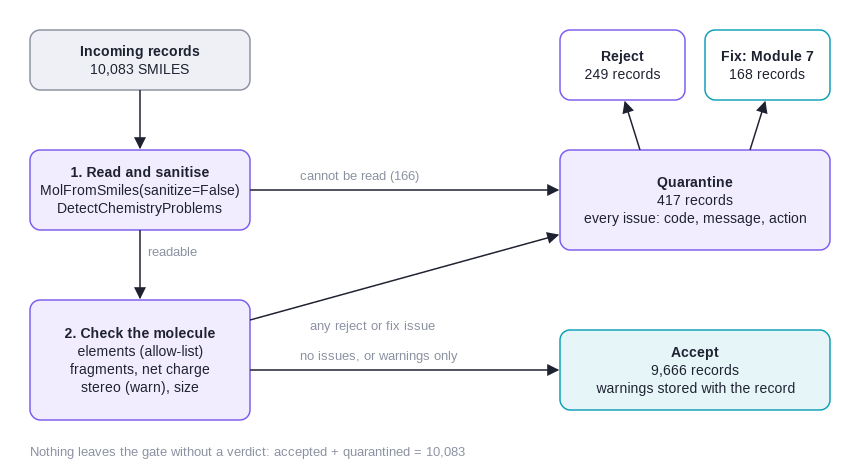
Now the whole library. Each record gets its issues, its codes and its verdict, in new columns
beside the original data, so nothing about the record is lost. This is the step a nightly job
would run unattended, so it reports with log, and the quarantine count is a warning: it is the
number someone should look at in the morning. The assert line stops the program with an error if
its condition is False; here it guards against the gate ever losing a record:
results = dirty.copy()
results["issues"] = [validate(s) for s in results["smiles"]]
results["codes"] = [";".join(i.code for i in issues) for issues in results["issues"]]
results["verdict"] = [verdict(issues) for issues in results["issues"]]
assert len(results) == len(dirty), "every record leaves the gate"
n_quarantined = int((results["verdict"] == "quarantine").sum())
log.info("validated %d records: %d accepted", len(results), len(results) - n_quarantined)
log.warning("quarantined %d records", n_quarantined)
INFO validated 10083 records: 9666 accepted
WARNING quarantined 417 records
The assertion is the point of the whole module: every one of the 10,083 records came out, either
accepted or quarantined. The quarantine table has one row per issue, so it can be filtered,
counted and handed to whoever fixes the source. The code is one chain of pandas steps, read from
top to bottom: keep the quarantined rows; explode turns a row with two issues into two rows with
one issue each; assign adds columns for the code, message and action of each issue (each
lambda t: receives the table so far); then the wanted columns are kept, the rows are sorted and
renumbered:
quarantine = (
    results[results["verdict"] == "quarantine"]
    .explode("issues")
    .assign(
        code=lambda t: [i.code for i in t["issues"]],
        message=lambda t: [i.message for i in t["issues"]],
        action=lambda t: [i.action for i in t["issues"]],
    )[["id", "smiles", "code", "message", "action"]]
    .sort_values(["id", "code"])
    .reset_index(drop=True)
)
print(len(quarantine), "issues on", quarantine["id"].nunique(), "quarantined records")
print(quarantine[["id", "code", "message"]].head(6).to_string(index=False, max_colwidth=60))
541 issues on 417 quarantined records
         id    code                                                      message
ML-00006917 VALENCE Explicit valence for atom # 0 C, 5, is greater than permi...
ML-00007690   PARSE SMILES Parse Error: unclosed ring for input: 'ccc(O)c(cc1...
ML-00009561 VALENCE Explicit valence for atom # 0 C, 5, is greater than permi...
ML-00015388   PARSE SMILES Parse Error: unclosed ring for input: 'ccc(c8cn[nH...
ML-00021654 SOLVENT                                        solvent CCO (ethanol)
ML-00027465    SALT                           counter-ion Cl (hydrogen chloride)
The summary by reason is what a team reviews each day: which faults arrive, how often, and
which can be repaired. It counts records, not issues, over the whole library, so warnings on
accepted records appear too. A Counter (from the standard library's collections, imported in
the Setup block) is made for this: it is a dictionary that starts every count at zero, so each
record simply adds one to each of its reasons. Taking the reasons of a record as a set first means
a record with two issues of one kind is counted once:
records_per_reason = Counter()
for issues in results["issues"]:
    records_per_reason.update({(i.code, i.action) for i in issues})
summary = pd.DataFrame(
    [(code, action, n) for (code, action), n in records_per_reason.items()],
    columns=["code", "action", "records"],
).sort_values(["records", "code"], ascending=[False, True])
print(summary.to_string(index=False))
   code action  records
 STEREO   warn     4805
   SALT    fix       84
SOLVENT    fix       84
ELEMENT reject       83
  PARSE reject       83
VALENCE reject       83
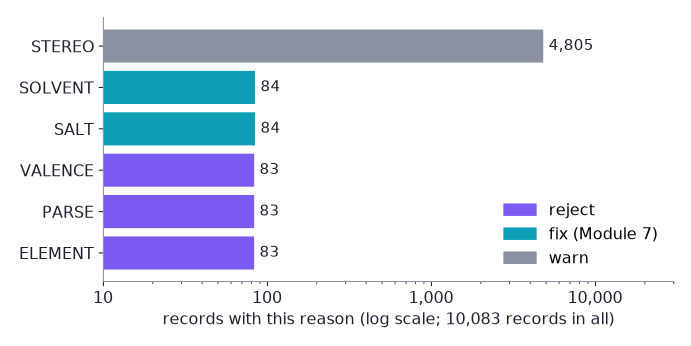
Two things stand out. Nearly half the records (4,805 of 10,083) have at least one unassigned
stereocentre or double bond: chemlib writes no stereochemistry, like many enumerated libraries,
so this is a fact about the source rather than a fault in individual records, and it is exactly
why it is a warning. And no record was flagged for a net charge, a mixture or its size: the
damaged library contains none (every salt add_defects wrote with this seed is a hydrochloride,
.Cl, which is neutral). Those checks are still worth running: the next vendor's file may be
full of them, and section 3 showed each one working.
Accepted records and the quarantine are written out side by side, as Parquet files (Module 3) in
the work folder. The issues are stored as their codes and messages, plain text that any tool can
read:
accepted = results[results["verdict"] == "accept"].drop(columns=["issues"])
accepted_path = WORK / "accepted.parquet"
quarantine_path = WORK / "quarantine.parquet"
accepted.to_parquet(accepted_path, index=False)
quarantine.to_parquet(quarantine_path, index=False)
n_quarantined = quarantine["id"].nunique()
assert len(accepted) + n_quarantined == len(dirty), "every record is in one file or the other"
log.info("wrote %d accepted records to %s", len(accepted), accepted_path.as_posix())
log.info("wrote %d issues on %d quarantined records to %s", len(quarantine), n_quarantined,
         quarantine_path.as_posix())  # fmt: skip
INFO wrote 9666 accepted records to work/accepted.parquet
INFO wrote 541 issues on 417 quarantined records to work/quarantine.parquet
5. Checks across records: duplicates
Every check so far looks at one record at a time. A duplicate is different: it is a perfectly good
record whose molecule is already in the table, so no record-level check can see it. It takes a
check across records, on identity. As in Module 3, the InChIKey is the identity: two records with
the same key are the same molecule, however their SMILES are written. We keep the first record (by
id) and flag the rest, with a pointer to the record they repeat. After sorting by id,
groupby("inchikey")["id"].transform("first") gives every row the id of the first record with
the same InChIKey; a row whose own id is different is a repeat:
readable = results[results["verdict"] == "accept"].copy()
readable["inchikey"] = [Chem.MolToInchiKey(Chem.MolFromSmiles(s)) for s in readable["smiles"]]
readable = readable.sort_values("id")
first_id = readable.groupby("inchikey")["id"].transform("first")
repeats = readable[readable["id"] != first_id]
print(len(repeats), "accepted records repeat an earlier one")
print(repeats.assign(repeats=first_id)[["id", "repeats", "defect"]].head(3).to_string(index=False))
109 accepted records repeat an earlier one
             id     repeats    defect
ML-00057592-dup ML-00057592 duplicate
ML-00073568-dup ML-00073568 duplicate
ML-00075590-dup ML-00075590 duplicate
There were 83 duplicates on record, so where do the other 26 come from? They are in the library
itself. As the chemlib documentation says, a few combinations of scaffold and substituents give
the same molecule by symmetry (a 3,5-disubstituted benzene with the two groups swapped is the same
compound), just as in real enumerated libraries. The validator found real duplicates that the
record of defects never listed.
Flagging, not deleting, is deliberate: two records of one molecule may carry different prices or assay results, and merging them is a decision for the next stage. Duplicates also hide behind salts and charges (the hydrochloride and the free base have different InChIKeys); Module 7 finds those after standardisation.
6. Checking the validator against the truth
A validator is software, and software is tested. Because chemlib recorded every fault it made,
we can compare the validator's verdicts with the truth. A confusion table puts the true fault in
the rows and the verdict in the columns, and counts the records in each cell; pandas makes one with
pd.crosstab. First we add an outcome column that marks the duplicates found in section 5:
isin tests whether each id is in the list of repeats, and .where(~flag, "accept, duplicate")
keeps the verdict where the flag is False (~ means "not") and writes the new label where it is
True:
results["duplicate flag"] = results["id"].isin(repeats["id"])
results["outcome"] = results["verdict"].where(~results["duplicate flag"], "accept, duplicate")
truth = results["defect"].replace("", "(none)")
print(pd.crosstab(truth, results["outcome"]).to_string())
outcome    accept  accept, duplicate  quarantine
defect
(none)       9557                 26           0
duplicate       0                 83           0
element         0                  0          83
invalid         0                  0          83
salt            0                  0          84
solvent         0                  0          84
valence         0                  0          83
Read it row by row. Every invalid, valence, element, salt and solvent record was quarantined (caught: 417 of 417), and no clean record was quarantined (no false alarms). Every duplicate on record was flagged (83 of 83), and nothing was missed. The 26 clean records flagged as duplicates look like false alarms in this table, but section 5 showed they are real: the record of truth is incomplete, not the validator. That is the usual situation with real data, and the reason a disagreement between a validator and a "truth" is investigated, never just counted.
A perfect score on faults we planted ourselves proves less than it seems. The validator was written
knowing what add_defects does; a new source will bring faults nobody planned for. The table is a
regression test, a test that checks a change to the code has not broken something that used to
work: it must stay perfect when the code changes.
Which reason codes did each kind of fault produce? This is where a validator's behaviour is
understood, not just scored. The codes column holds the codes of a record joined by ;, so we
split them and explode them into one row per code, then line each code up with its record's
fault:
quarantined = results[results["verdict"] == "quarantine"]
codes = quarantined["codes"].str.split(";").explode()
print(pd.crosstab(quarantined["defect"].reindex(codes.index), codes).to_string())
codes    ELEMENT  PARSE  SALT  SOLVENT  STEREO  VALENCE
defect
element       83      0     0        0      47        0
invalid        0     83     0        0       0        0
salt           0      0    84        0      36        0
solvent        0      0     0       84      40        0
valence        0      0     0        0       0       84
Each fault produced the reason it should, and only that blocking reason. The table counts issues,
so two details need explaining. The valence row shows 84 issues for 83 records: one record had its
five-bond carbon written in front of a carbonyl oxygen (C(C)(C)(C)(C)O=C(...), which gave that
oxygen three bonds as well, and DetectChemistryProblems reported both atoms. And the stereo
warnings on element, salt and solvent records are real too: those molecules have unassigned
stereocentres like half the library. The records that failed to parse or sanitise carry no stereo
warning, because no further checks can run on a molecule that cannot be read.
7. From a lesson to a pipeline
The gate here checks 10,083 records in about a quarter of a minute on a laptop, one record at a
time. The same two functions scale to millions: run them on batches (a few thousand records at a
time) from chemlib.stream (or chunks of a file), write each batch's accepted records and
quarantine to Parquet, and spread batches over several processes, which lets a computer use all
its processor cores at once (Module 9). Keep the reason codes stable, because dashboards and
alerts count them (Module 14), and record the validator's version with its output, so a record
quarantined last month can be explained today (Module 13).
The ChEMBL database has curated its structures with an open-source pipeline built on RDKit since release 26, the ChEMBL Structure Pipeline (Bento et al., 2020). Its checker returns for each issue a description and a penalty score from 0 to 9 that reflects how serious it is, the same idea as our code, message and action. Module 12 returns to validation for whole records and tables, with Pydantic and Pandera, two Python packages for checking data.
Try it yourself
The homework is a few questions, answered by running code like the code above: in a new cell at
the end of the notebook, or in a script. It is at the end of the lesson's page, and in
homework.md in the module's folder. The answers are published after the cohort's deadline.
Further reading
- Fourches, D., Muratov, E. & Tropsha, A. (2010). Trust, But Verify: On the Importance of Chemical Structure Curation in Cheminformatics and QSAR Modeling Research. Journal of Chemical Information and Modeling, 50(7), 1189–1204. https://doi.org/10.1021/ci100176x
- Bento, A. P., Hersey, A., Félix, E., Landrum, G., Gaulton, A., Atkinson, F., Bellis, L. J., De Veij, M. & Leach, A. R. (2020). An open source chemical structure curation pipeline using RDKit. Journal of Cheminformatics, 12, 51. https://doi.org/10.1186/s13321-020-00456-1
- The ChEMBL Structure Pipeline (source code and documentation, including its checker). https://github.com/chembl/ChEMBL_Structure_Pipeline
- The RDKit documentation. The RDKit Book, section "Molecular Sanitization". https://www.rdkit.org/docs/RDKit_Book.html#molecular-sanitization
- Daylight Chemical Information Systems. Daylight Theory Manual, chapter on SMILES (valences and the rules for writing a valid SMILES). https://www.daylight.com/dayhtml/doc/theory/
Homework
Answer each question by running code like the code in the lesson: add a new cell at the end of the
lesson's notebook (in Colab, + Code) and work there. Run the whole lesson first, so that its
functions (parse, validate, verdict and the checks) and its settings exist. If you are in a
cohort, you will be told where to send your answers; everyone can check theirs against the answers
published after the cohort's deadline.
- Builds on section 2, "Capturing RDKit's messages". Run the lesson's
parsefunction on these five records:C1CC(C,c1ccncc1,N(C)(C)(C)C,c1ccnc1,CC(=O)O[Na]. For example,mol, issues = parse("C1CC(C")and thenprint(issues). Which can be read, and for each that cannot, what reason code and message does it get? One of them is read without complaint although a chemist would object: which, and why does sanitisation (RDKit's check of valences and aromaticity) accept it? - Builds on sections 1 and 4. Make a new damaged library with
chemlib.add_defects(chemlib.library(5_000, seed=11), rate=0.08, seed=12). Run the gate on it: for each SMILES,validategives its issues andverdictturns them into "accept" or "quarantine", as in section 4. How many records are accepted and how many quarantined? How many quarantined records could Module 7 repair, because every one of their issues has the action "fix"? - Builds on section 3. The selenium records made by
add_defectsare written with[Se], an atom in square brackets. In SMILES, an atom in brackets gets exactly the hydrogens written inside the brackets, here none, so the selenium is left with an unpaired electron: a radical. Write acheck_radicalscheck in the style of section 3: it takes a molecule and returns a list of issues, here one with the codeRADICALwhen any atom hasatom.GetNumRadicalElectrons()above zero. Add it toCHECKS(CHECKS.append(check_radicals)) and run the gate on your library from question 2. Which kinds of fault does it fire on? Is it a second reason for records that were already quarantined, or does it catch anything new? - Builds on section 3, "Stereochemistry". The lesson's stereochemistry check returns its issue
with the action "warn", so those records are accepted. Change that action to "reject" and run
the gate again. How many records of your library from question 2 would now be quarantined? The
molecules of
chemlibare built on a few core structures, listed as SMILES inchemlib.SCAFFOLDS. Find the two scaffolds that contribute the most of the new quarantines, and point to the atom that makes each one a stereocentre. - Builds on sections 5 and 6. Build the confusion table (true fault in the rows, the gate's outcome in the columns) for your library from question 2, including the duplicate check across records from section 5. Are there clean records flagged as duplicates? For one of them, show the two SMILES and explain why they are the same molecule.
- To think about. Builds on the whole lesson, especially section 7. A vendor sends you an update file every week, and your validator will change over the year (a new element allowed, a stricter size limit). Design what you store for each record so that, a year from now, you can say why any record was accepted or quarantined, and re-run only the records whose verdict a new version of the validator could change. Who in a team should own the allow-list of elements and the salt and solvent lists, and how would a change to them be reviewed?
How was this module?
Found this module useful? ★ Star the course on GitHub: it helps other chemists find it.